
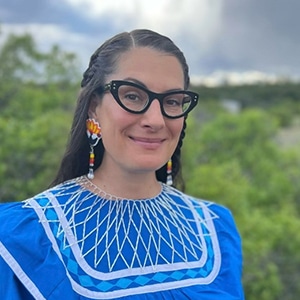
In this interview, Aimee speaks about Cultural Survival’s approach to supporting Indigenous communities around the world, the diverse ways communities defend and strengthen their rights, and how preserving a sacred rain cave is an example of holistic biocultural conservation.
In 1972, the Brazilian government launched a programme called POLAMAZÔNIA, which prioritised fifteen landscapes for mineral, livestock, and agro-industrial production. This followed on from Operação Amazônia only a few years before, which was supposedly intended to ‘Bring people without land to a land without people.’
The problem was, and still is, that these lands were never without people. Remote and thriving wild landscapes where Indigenous Peoples live have frequently across history been described as empty and untamed wildernesses, erasing the existence and rights of the communities who live there and whose Peoples have cared for the land over hundreds or thousands of years.
1972 was also the year that Cultural Survival was founded, an organisation dedicated to defending the rights of Indigenous Peoples around the world.
“Since inception, Cultural Survival has been a rights-based organisation working in solidarity with Indigenous Peoples and local communities in support of their rights and their self-determination,” says Aimee Roberson, who became Executive Director of Cultural Survival in 2024. “And so, that is written into the framework of how we do all of our work, including grant-making.”

Cultural Survival supports the Yvy Pyte community of the Paĩ Tavyterã Indigenous People in northwest Paraguay, who face ongoing regional conflict and land rights violations. © Cultural Survival
Rights-based grant-making
In practice, this means letting go of their own agendas as funders, and letting the communities and organisations they work with determine the priorities of the work funded by grants by their various funds.
“We aim to be in long-term relationship with our community partners,” says Aimee. “So we will always have a conversation with the communities about the project and how it supports their self-determination, supports their rights, and aligns with their sovereignty.”
“A lot of the funding that comes to us now, thankfully, is unrestricted. This means we’re able to pass on a lot of flexibility to the communities and let them determine what their needs are and what kind of project they want to implement within the community using those funds.”

One of Cultural Survival’s partners in Namibia is the Nama Traditional Leaders Association (NTLA), which promotes Indigenous rights, youth leadership, and cultural preservation. © Cultural Survival
Diverse approaches to Indigenous Peoples’ rights
Our Biocultural Diversity Programme supports the Keepers of the Earth Fund, which has supported almost 400 projects in 40 countries since 2017 directly to Indigenous communities and organisations.
“The Keepers of the Earth Fund supports a broad array of projects,” says Aimee. “Some of them are more obviously related to specific rights issues, and others more foundational, like language revitalisation, enhancing traditional governance, food sovereignty, all kinds of things that keep the community and their traditional ways intact. From an Indigenous perspective, all of those things are foundational to being able to have self-determination and then protect their rights.”
Cultural Survival has various other funds addressing different aspects of Indigenous Peoples’ rights based on principles defined by Indigenous Peoples themselves in the United Nations Declaration on the Rights of Indigenous Peoples. Aimee says, “Our Community Media Fund aims to support communities that want to exercise their right to freedom of speech, freedom of organisation, freedom of religion, and language.
“Projects we fund that focus on Indigenous languages support communities in continuing their cultures and thereby resisting assimilation and strengthening self-determination.”
“Our languages encapsulate who we are as Indigenous Peoples, who our communities are, and how we’re in relationship to our homelands and to each other.”
“Indigenous languages are so important, and so to support their protection is a way of resisting the destruction of our cultures. This is tied to Article 8 of the Declaration, which states that Indigenous Peoples should not be subjected to forced assimilation or the destruction of their culture.
“We also have specific advocacy funds that support the right to Free, Prior, and Informed Consent and are related to all kinds of things, such as various extractive industries within Indigenous territories and how communities are addressing threats to their homelands, cultures, and self-determination.”

Pãi Tavyterã is a Guarani language spoken by about 600 people in eastern Paraguay, a country which holds 19 Indigenous languages alongside Guaraní, which is spoken by over 90% of the population. © Cultural Survival
Preserving a sacred rain cave
So what does the holistic approach of Indigenous-led projects supported by Cultural Survival actually look like?
“There is a project which we supported just recently in 2026 through our Keepers of the Earth Fund, which Synchronicity Earth supports through unrestricted funding, with the Yacunani, a Sa’an Savi-speaking community in Oaxaca, Mexico.
“Their interest is in continuing to preserve traditional knowledge regarding their worldview and spirituality, and it also has really important environmental benefits.
“They’re looking to restore their sacred rain cave, Kava Tyi’ma, which was historically used for ceremony specifically related to traditional agriculture. Their project includes building an additional water tank and also hosting a festival featuring an ancestral sport that’s part of their ceremonies called Seku.”

A game of seku (meaning twisted), referring to the stick used to hit the ball. Before the ball is lit, a ritual is performed, asking the Earth for permission to play, and that no one gets hurt. © Cultural Survival
“This includes creating a safe access path with eco-friendly wood and stone stairs through community voluntary labour, and looking at water infrastructure from the cave, which means constructing a new storage tank to prevent water waste and conserve water. This is helping them to secure water not only for local consumption, but also for the ecosystem of the cave.
“Another aspect is a ceremony around Kava Tyi’ma that includes organising a traditional ritual, an official inauguration, and the Seku sports tournament that includes youth as well as adults and is integrated with some of the school activities.
“On one level, you could say it is about cultural significance, but actually this project touches on traditional knowledge, spirituality, ceremony, water and ecosystem conservation, and connecting youth and adults and elders, resulting in multi-generational engagement and intergenerational transfer of knowledge.
“It’s going to help them conserve water for the ecosystem as well as their municipality, and in a way that’s very meaningful and integrated into the community and the culture as a whole.”

Community volunteers building water infrastructure above the cave to help create a sustainable communal water source. © Cultural Survival
“You can see that this is the type of project that is very multifaceted and might be hard to explain to a funder who has a very specific or narrow view of what conservation is. But through an Indigenous lens, this work helps to reinforce values around conserving water and the environment, and safeguards the cultural importance of the cave for many generations to come.”
It is not just: ‘We’re going to close off the cave and let it be.” It is: “How can we be in harmony with the cave?”
Synchronicity Earth supports Cultural Survival’s Keepers of the Earth Fund through the Biocultural Diversity Programme.
Our funding model is similar to that of Cultural Survival as we also develop long-term relationships with local partners and speak to them about how we can provide core and flexible funding for them to direct towards their priorities.
To learn more about how environmental philanthropy is evolving to become more equitable and trust-based, sign up for our Reimagining Philanthropy newsletter on LinkedIn, and read the latest issue featuring Aimee’s description of rights-based grant-making.


