Christian Schwarzer is one of the founders of the Global Youth Biodiversity Network (GYBN), which connects young people to engage with biodiversity policy and decision-making, and has dedicated most of his life towards environmental issues.
After 16 years growing GYBN, we discuss what he’s most proud of, the necessary transition that follows ageing out of a youth organisation, the importance of flexibility and trust in partnerships, and how building a dedicated community is more valuable than metrics can really quantify.
Building a global community
What has the Global Youth Biodiversity Network achieved in its first 16 years?
There is no single biggest or most outstanding moment.
When we started GYBN, I was still in university, figuring a lot of things out – there was no blueprint. We just did what felt exciting.
Now, GYBN is a movement – a community – and having built this over the last 16 years, the real success is that we're still around and have 70 National Chapters all over the world.
Each Chapter is a platform for individuals and youth organisations to come together to work on biodiversity, through ground projects, campaigns, events or advocacy work.
For example, our GYBN USA Chapter is working with the GYBN South Sudan Chapter to raise funding in a North-South collaboration. Last year, our GYBN Austria Chapter did some crowdfunding to support GYBN Ethiopia.
They're becoming friends because they're working for a joint cause, and GYBN gives them a place where they feel safe and welcome. For me, that's the biggest achievement.
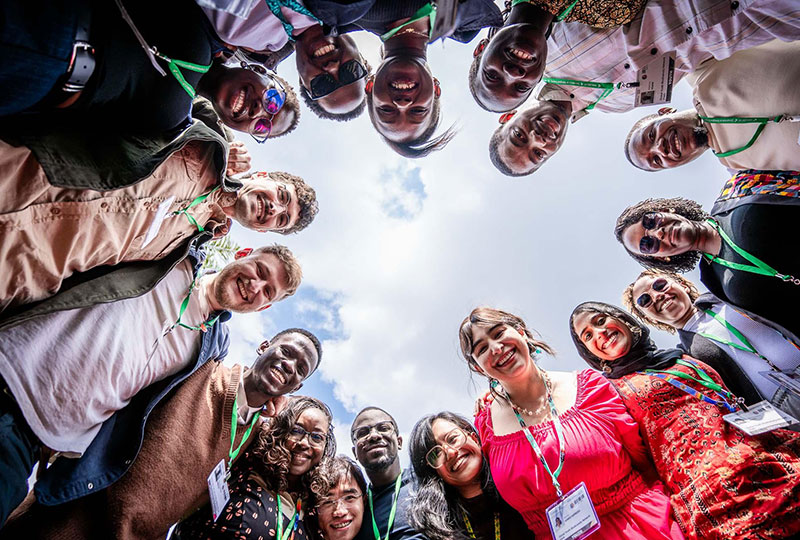
A group of GYBN youth representatives at the CBD Subsidiary Body on Scientific, Technical and Technological Advice (SBSTTA-28) in Kenya, July 2026. Image credit: IISD.
There are a lot of numbers we usually share when we talk to donors and supporters, and I think they're pretty impressive too.
We have organised more than 24 workshops all over the world. We've supported hundreds of young people to participate in Convention on Biological Diversity (CBD) meetings with scholarships, and awarded several hundred fellowships and micro grants to support projects on the ground. We've reached more than 12 million people with our Stop the Same campaign. We have 1.25 million youth from 172 countries that we're supporting. I'm very proud of these numbers, but they're not all that matters.
What makes me proudest is when I come into a room and see these people from all these different backgrounds, from Morocco, from Fiji, from Bolivia, from the UK, from Germany, not talking to each other as random strangers, but as friends.
To really realise that we're on this one planet and we have to solve this together – that's what I was always hoping to achieve with GYBN. And I think we did it.

GYBN members representing youth at the youth COP14 in 2018. Image credit: GYBN.
Pushing for a fairer future
What impact has GYBN had on youth participation in global biodiversity policy?
When we first started GYBN, there was no community to speak of. Minus a few individuals in Montreal, there were no youth participating in CBD meetings before 2010.
Now, we have 500 youth from all over the world joining the Conference of the Parties (COP). Attendees and government delegates are seeing our youth badges, our events, our youth pavilions, seeing young people. In 2022, we had 3,000 people out on the streets in Montreal peacefully protesting and raising awareness for the importance of biodiversity conservation and an ambitious biodiversity agreement.
Of course, these aren't the numbers the climate movement mobilises, but in terms of the CBD, we brought visibility. But also, we're being taken seriously. We make proposals that many, many governments all over the world support.
At COP16 in Colombia, our policy suggestions were supported by 58 governments. This shows that we're not just making proposals focused on youth issues – we're demonstrating that young people have perspectives worth including, adding real value and expertise.
Sometimes governments come to us to ask for GYBN's perspective. But what we also know is biodiversity conservation isn't just happening in some conference centre.
It's about what we do every day – how we protect nature in our backyard, how we talk about it, what we do with communities – plus the socio-economic dimension, like poverty alleviation, 'decolonising' our minds. So for GYBN, it was always important that we use the CBD as a way to push for policy change.
In terms of impact in the community, we have 70 Chapters doing amazing projects all over the world. For instance, GYBN Madagascar changed the curriculum in their entire country – biodiversity education is now part of the school curriculum because GYBN Madagascar pushed for it and didn't give up.
GYBN Mexico, our oldest Chapter at 10 years strong, lobbied their parliament against a law that would have expanded the area for illegal logging – and they managed to stop it.
These Chapters are coming together, doing the work, and really showing the world what is possible. We're living North-South collaboration, we're living global solidarity, and we're demonstrating that there is a future.
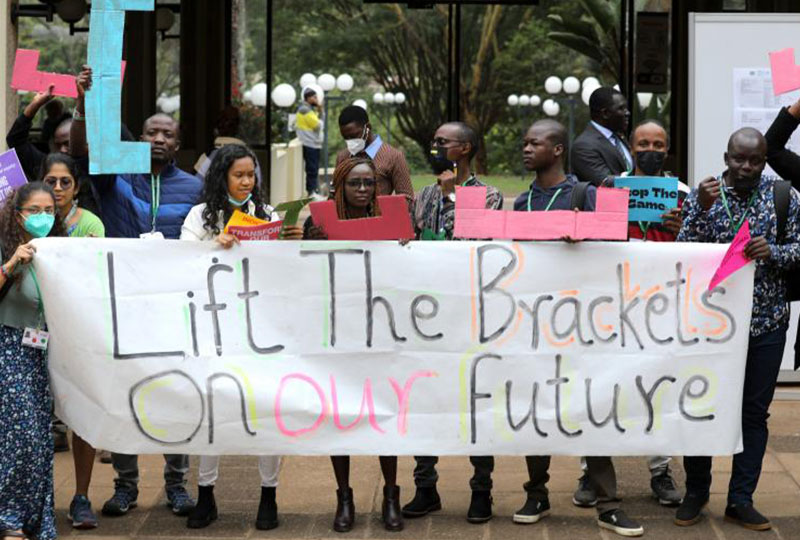
A group of GYBN youth representatives advocating for their right to be included in youth education decision-making. Image credit: GYBN.
Challenges and solutions
What are the biggest challenges facing youth-led environmental organisations?
For GYBN, there's certainly a challenge related to financial stability.
For the first five or six years, we operated project to project, with zero funding – everything was voluntary. Now the network has grown so much that you need resources just to maintain it. We'd love to give an annual fixed budget to each Chapter so they can implement good projects, but that's both logistically and financially very challenging to raise. We have funding for specific events, like the Conference of the Parties in Armenia, but it's much harder to get funding that's flexible enough to respond to demands from the community which come up unexpectedly.
Likewise, for much of our existence, we depended solely on government funding. I'm grateful to every government that supports us, but government funding comes with restrictions, heavy administration, long contractual processes. It makes sense – it's taxpayers' money – but often the funding is only for specific projects, limited in time.
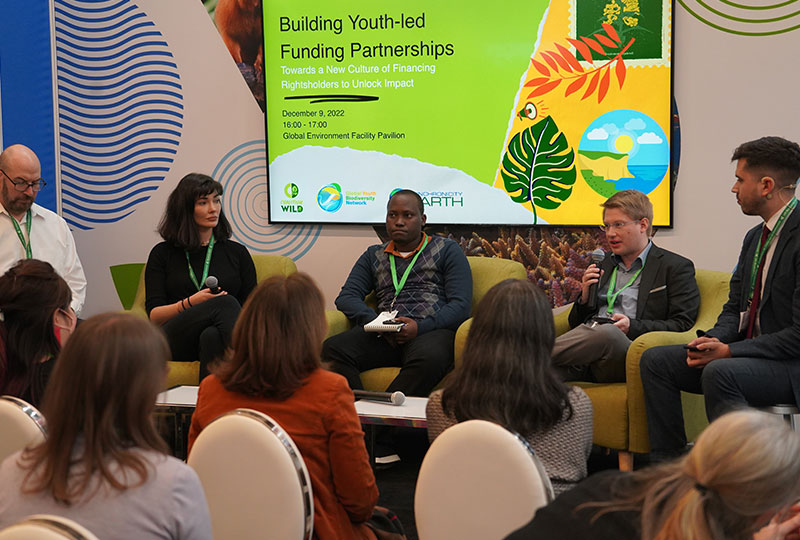
L-R: Karl Burkart, Julia Jackson, Derrick E. Mugisha, Christian Schwarzer, and Félix Feider at a Global Environment Facility (GEF) Pavilion youth panel session, CBD COP15. Image credit: Olivier Besson, GEF
So, what kind of support do youth-led organisations need from funders?
Honestly, Synchronicity Earth are lifesavers, and not just because you support GYBN financially.
You're flexible, we can make adjustments – micro grants for our Chapters, strategic initiatives to build movements.
I'm really grateful for how unrestricted the support is. But truly, the greatest thing about Synchronicity Earth is the people, because they care.
I can talk to Félix, Isha, or Agrita about a problem we're trying to solve without holding back, and that makes all the difference. There's a human connection – I can be open, I can be myself.
A couple of years ago we had a big legal issue, completely out of our control, and I didn't know what to do. I could talk to Synchronicity Earth about it, without judgement, to find solutions as partners – and that's very different from a lot of funders.
What I really like is that Synchronicity Earth's leadership gives people the time to sit down and connect on a human basis. I wish more organisations could see this as an investment.
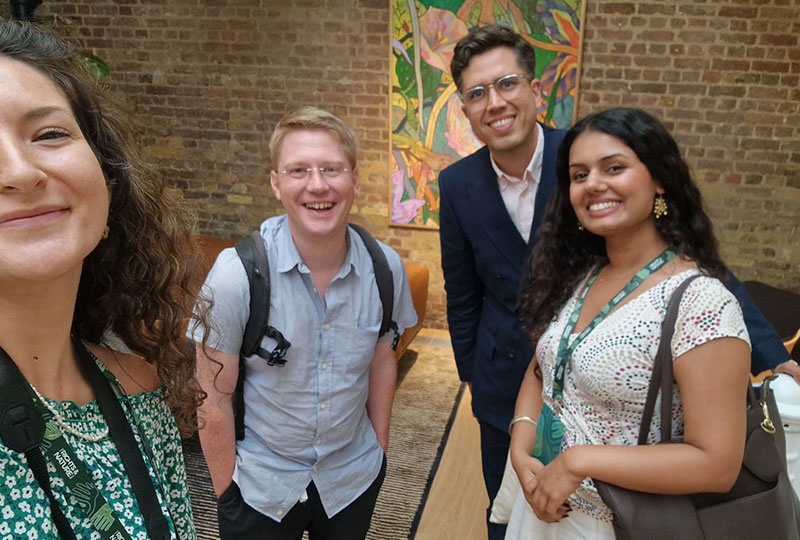
Christian with Synchronicity Earth team members Geanie Cresswell, Félix Feider and Agrita Dandriyal at the Rights & Nature Hub, London Climate Action Week 2026.
A personal challenge
And I want to be honest about a personal challenge.
I've been with GYBN for 16 years, but it's a youth network, and we want to keep it youth-led. So what does that mean for a co-founder ageing out of the youth age? How can you still be useful?
For me, it's about finding a pathway to transition out – to still support and give a helping hand, but not dominate it or make decisions for people. I'm happy to be at this stage, but it's challenging to let go.
We've now created Future Ancestors Rising, the organisation that legally hosts GYBN, and are moving into a space of intergenerational projects and building biodiversity-sector movements more broadly – while still giving GYBN a safe home to operate as a youth-led organisation.
Every organisation needs a transition plan, because you can't be youth forever. You need a mechanism to maintain the capacity and expertise that's been built up over years. That's easier said than done.
It's very cheesy to say, but I almost feel like a dad who's done his job, and now the kids are moving on.
Your organisation grows, and you have to find a new role for yourself as a founder. Now, we have members joining who are 15, 16 years younger than me, and I'm glad because it means GYBN is still attractive to someone in their late teens or early twenties, which is wonderful.
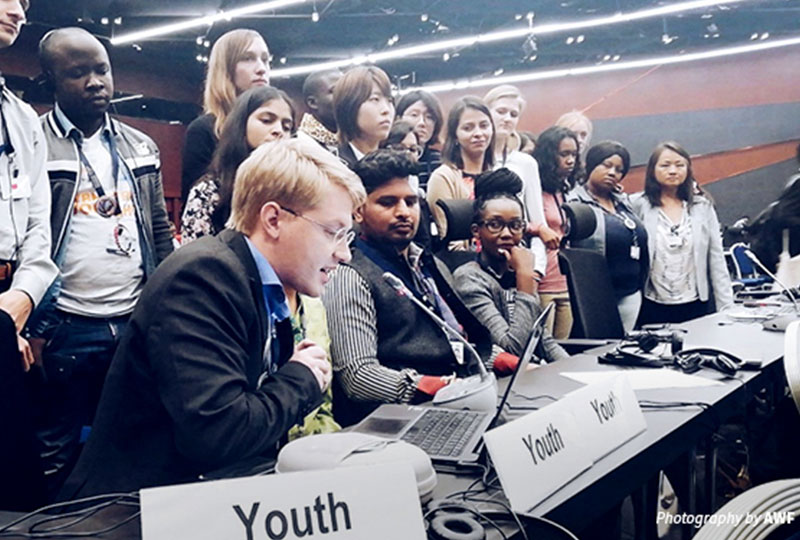
Christian Schwarzer speaking at a Global Youth Biodiversity Convention, CBD COP14, in 2018. Image credit: AWF.
Making movements, together
What's next for GYBN and Future Ancestors Rising and how can we support you in future?
We have a lot of ambitions. Through Future Ancestors Rising, we want to focus on intergenerational movement building – organising new activities so GYBN can keep thriving as a community. So, of course, we welcome any support to continue these programmes and fellowships.
But, if Synchronicity Earth told us tomorrow that the funding wasn't there, but asked to work together on another level, we'd still absolutely love to do that – really, we work together because we share objectives and values. We recognise all the connections within nature, how biodiversity is underpinning everything.
I'd love to think about co-organising an event – a workshop, something creative, built jointly. The launch of the Ecologies of Empowerment report is a fantastic example of what we can do together, so more of this kind of collaboration.
We've been partners for almost ten years now – so let's see where we go from here. But most important: let's keep the human and trust-based relationship.
Synchronicity Earth has partnered with the Global Youth Biodiversity Network for almost a decade, and continues to provide flexible funding through our Chrysalis Youth Fund, co-designed with young people, which allows GYBN’s 70 National Chapters to respond to community needs as they arise.