
Culture Change
Supporting lasting positive change for nature is as much a cultural challenge as a scientific, technical, intellectual, or financial one. Addressing biodiversity loss and climate breakdown means engaging with the cultural norms and practices which drive them, and which shape how we respond.
Where change begins
Culture change is complex, multi-dimensional, and difficult to measure. We do not claim to shift cultural norms and behaviours at scale. But we are committed to working – with others – at the places where change begins: in how we ourselves operate and ‘show up’ in the world; in the shifts in practice we believe are needed across conservation and environmental philanthropy; and in the narratives, stories, and acts of imagination that can help open up a different future.
From our experience working with Indigenous Peoples and local communities, with scientists and environmental funders, we know that protecting nature is not just about conservation science, research, and resources. It is about how we understand and relate to the natural world, the way conservation and philanthropy have traditionally operated, how we make sense of the world through the stories we tell about nature and our place within it and – ultimately – about how we live.
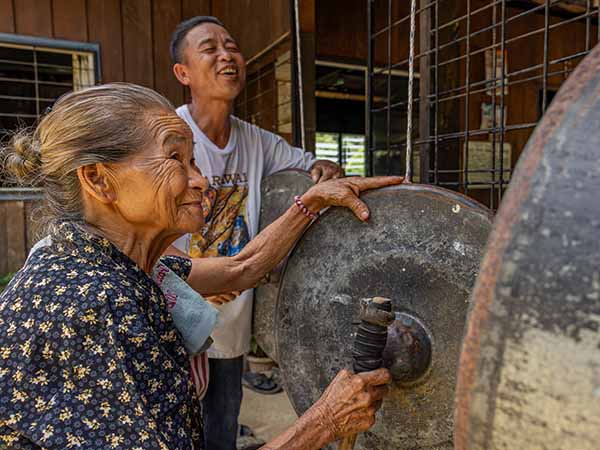
Intergenerational knowledge exchange in the Dusun Community, Orang Asal, Sabah, Borneo, Malaysia © Chris Scarffe
“They say when all you have is a hammer everything looks like a nail. When all you have is an intellect everything looks like a problem to be solved or things to be categorized or troubleshooted. It’s a very specific modality, but it doesn’t really engage all that well with earth.”
– Pat McCabe (Weyakpa Najin Win, Woman Stands Shining)
We explore cultural engagement in three key areas
The culture we ‘swim in’
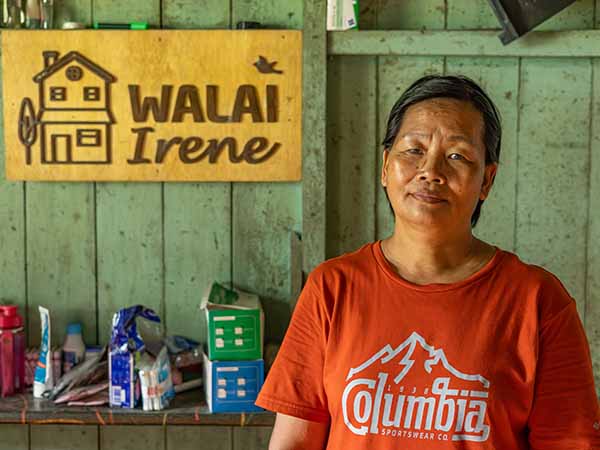
How do cultural beliefs and practices in society drive the nature and climate crises? Which cultures offer solutions that science and technology cannot provide?
Funding and practice

How do existing practices in conservation and philanthropy shape ‘how things are done’, and what can we do to support a more effective and equitable sector?
Alternative Futures
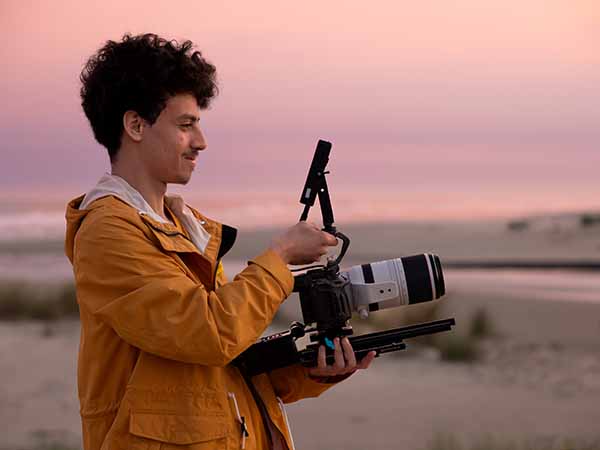
How can cultural expression – art, stories, film, music – help us to explore new ways of looking at the world and imagine alternative visions of the future?
Images above (left to right): Irene Tani Kodoyou, member of the Dusun community in Ulu Papar, Sabah, Malaysia © Chris Scarffe; Mohd Izuan, iStock; Lucas Machado Rodrigues, Instituto Curicaca © Chris Scarffe
Culture change in practice
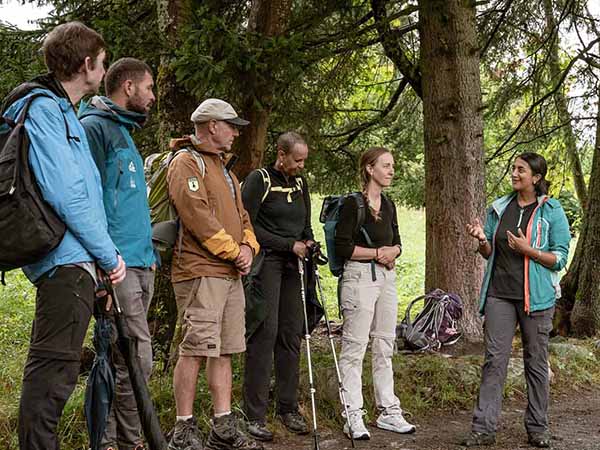
Letters to the Earth collaborated on a creative hike with SATI Sustainable Alpine Tourism Initiative © Olly Bowman
Letters to the Earth (LTTE) uses outdoor immersion, the arts, and storytelling to inspire a love of nature and build mass engagement in environmental action. Working with young people, community groups, and sustainability leaders across sectors, they are leading a cultural shift that places respect for the natural world at the centre of how we live. Synchronicity Earth recognises that one of the deepest challenges facing conservation is a widespread disconnection from nature, a problem that cannot be solved through science or policy alone. LTTE works in this space, shifting the values and narratives that shape how people relate to the living world.
We were the first funder to provide core funding for LTTE, giving them the flexible, unrestricted support that is hardest to access but most essential for growth. Beyond funding, we have partnered with them at London Climate Action Week and continue to connect them to relevant learning, partners, and networks across our community.
“Letters to the Earth have been instrumental in me weaving myself closer and closer to nature. The gentleness of LTTE alongside the impact they have, is testament to how we can gather together and have a big voice without shouting.”
– Participant in LTTE Nature Think Tank webinar, Letters to the Earth
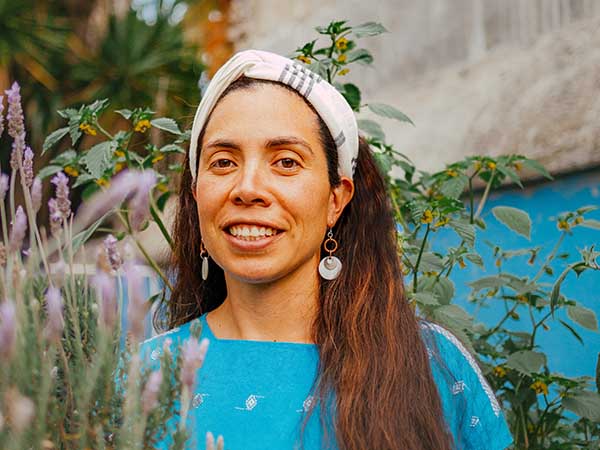
Ameyali Ramos facilitates Synchronicity Earth’s Conservation Funder Learning Circle
Environmental philanthropy needs to grow, but it also needs to change. Individual funders can deliver real impact for nature, but acting together opens up the possibility of more transformative, sector-wide shifts in how conservation is funded and delivered.
In January 2025, Synchronicity Earth incubated the Conservation Funder Learning Circle, bringing together a group of our donors to collectively explore how to ‘reimagine philanthropy’. Sessions have explored trust-based funding, rethinking due diligence, shifting power, and what it means to truly listen in a conservation context. Each session is facilitated by Ameyali Ramos, our Reimagining Philanthropy Adviser, who ensures all voices are heard and conversations remain grounded and productive.
By convening this space, we contribute to a collective effort to rethink the culture of conservation philanthropy, reflecting on and adapting our own practice and modelling the practice we believe the sector needs.
“The most insightful elements were concrete examples of foundation actions paired with discussions of the high-level questions we all face. This blend of practical examples and shared strategic dilemmas was particularly valuable.”– Anonymous, Conservation Funder Learning Circle participant
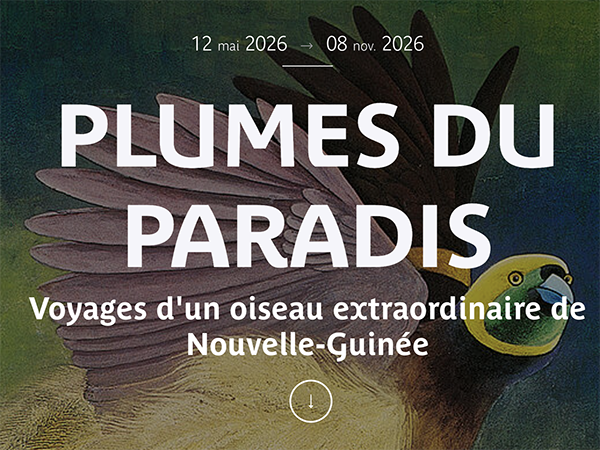
The exhibition runs from May 12th to November 8th, 2026
What does it mean to imagine a different relationship between humanity and the natural world? Sometimes the most powerful answers come not from policy or science, but from art.
‘Plumes from Paradise’ is an innovative exhibition at the Musée du quai de Branly – Jacques Chirac in Paris (May–December 2026), tracing more than two millennia of relationships between people and birds-of-paradise, from Oceania to Asia and onward to Europe and the Americas. Weaving together art, science, anthropology, and environmental history, it offers audiences a vivid reimagining of how humans and nature can coexist.
Synchronicity Earth’s Melanesia Programme Manager, Miriam Supuma, served as a technical expert to the exhibition and will participate in a symposium bringing together scientists, artists, and curators to explore how artistic representation of forests can drive environmental action.
In this way, Synchronicity Earth acts as a bridge between different sectors and spaces, acting as a sounding board and connector to support exhibitions and artistic explorations, linking to and promoting ecological and place-based knowledge from across our network, and making the case that nature and culture are two sides of the same coin.
“For the Indigenous Peoples of New Guinea, the birds are more than simply part of the landscape: they are sacred beings, messengers from the world of spirits and the voices of our ancestors, and mediators between the physical and the spiritual world.”
– Miriam Supuma, Melanesia Programme Manager, Synchronicity Earth
How we work
Culture change begins at home: how we work as an organisation reflects our values. We look to balance strategic clarity with genuine openness to new opportunities and emerging ideas and practice. We combine rigorous planning with an inherent willingness to follow unexpected connections; Western scientific frameworks with traditional ecological knowledge; and the urgency of the task with the patience that deep change requires.
Much of our most important learning happens in these in-between spaces – in the relationships we nurture, the conversations we join both within and beyond conservation and philanthropy, and the unplanned connections that emerge from them. In our experience, cultural norms and practices can start to shift when the right people find each other, when ideas whose time has come find the conditions to take root, and trusting, long-term relationships between allies are given time to flourish. That is the synchronicity in our name.
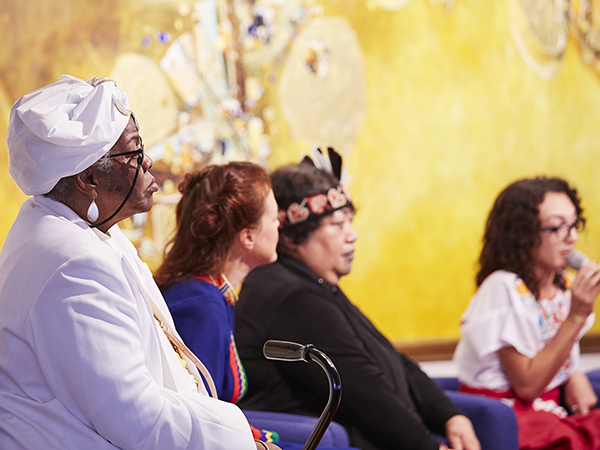
Indigenous wisdom keepers at the Flourishing Diversity Summit at University College London, 2019 © James Wicks
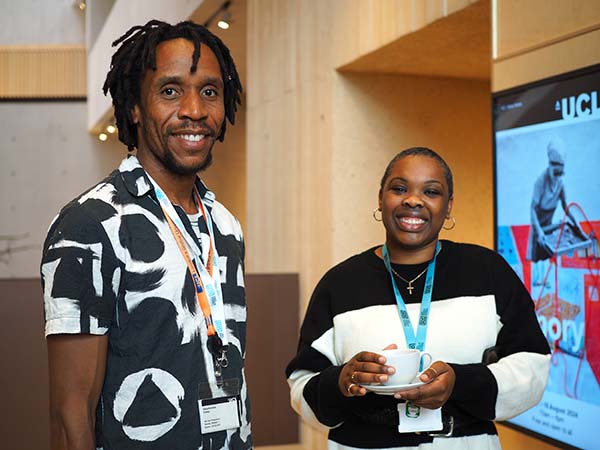
Manu Maunganidze, Co-Director of SOS-UK © Maar Dinu
Our commitment to diversity and inclusion
Diversity within the UK environment sector – in terms of race and ethnicity – remains incredibly low, compared to almost all other sectors. Synchronicity Earth believes that, as a member of this sector, we have a responsibility to help reduce the barriers that prevent it from being fully inclusive and representative of the communities it serves, wherever those communities are.
Synchronicity Earth has supported The RACE Report, run by Students Organising for Sustainability UK (SOS-UK), with small grants over several years, enabling them to launch a press campaign around the inaugural report, hold the RACE Summit in July 2024, and make the reporting process more accessible for smaller organisations.