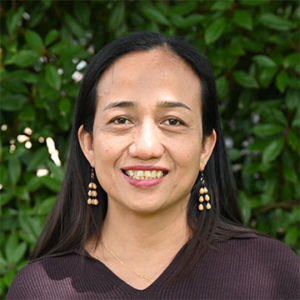
 Katherine (Kate) Mana Galido is a conservationist from the Philippines with nearly three decades of experience in environmental advocacy, community empowerment, and sustainable resource management. She joined Synchronicity Earth as Southeast Asia Affiliate in February 2026.
In this interview, Kate talks about her first experiences working with communities in a remote coastal community in Palawan, the opportunities and challenges for conservation in Southeast Asia, and why working with local communities is key to sustainable, long-term nature protection in this incredibly (bio)diverse region.
From medicine to zoology
Q: Where did you grow up and how did you get into conservation as a career?
I grew up in Nueva Ecija, north of Manila, a place known as the ‘rice granary’ of the Philippines. It’s mostly agricultural land, so there’s not much nature there!
I studied Zoology as a pre-medicine course at the University of the Philippines Los Baños, and had the opportunity to take different zoology subjects. At the time, I didn’t even know it was possible to have a career studying animals or the environment, but a friend mentioned that Zoology was a good option. At first, I was going to take wildlife zoology because I didn’t know how to swim and it seemed more practical, but I saw a dolphin and just fell in love! My professor in the marine mammalogy class was a dugong expert and I became his student assistant. I learnt so much from him about marine mammals, and that’s where my love of the ocean began!
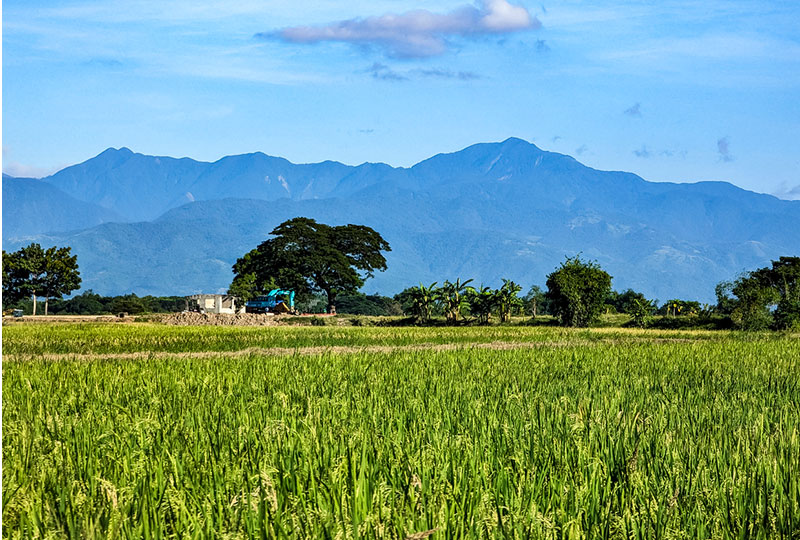
Rice fields in Nueva Ecija with the Sierra Madre mountain range in the background. Image: MDV Edwards, iStock
Q: Can you tell me more about that first job you had: Where was it? What were you doing?
After I finished my undergraduate degree, I was still undecided about what I wanted to do.
But then a college friend sent me some information about a job posting in Palawan, one of the last ecological frontiers in the Philippines. I was lucky that my first experience in the field was doing marine research for a community-based coastal resource management project in such a biodiverse place, full of natural wonders! Working with a coastal community of Tagbanua Indigenous People in Coron, Palawan was a turning point for me. Initially I committed to two years, but I ended up staying there for 10!
Palawan is a paradise for environmentalists. I was working on Lagas, a tiny and very remote island, rich in corals and a key habitat for the white-breasted sea eagle. This eagle – known as Kanog locally – is important for the island because in community lore it is seen as a protector of the island and its natural resources.
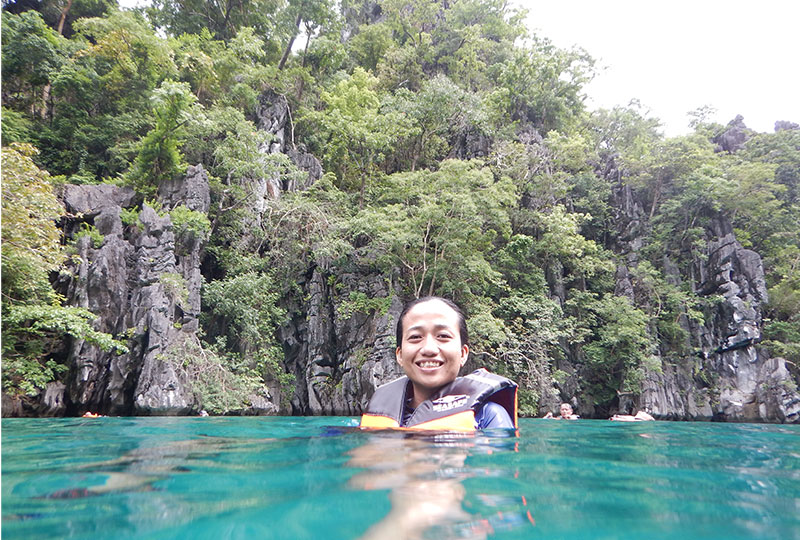
Coron Island. Photo taken in 2018 at the Kayangan lake. This lake is part of the Indigenous territory of the Tagbanua in Calamianes. © Tanya Conlu
Q: This sounds like a very different environment to the one where you grew up. What were some of the difficulties you faced, and what did you learn that has stayed with you?
To begin with, it was very challenging because I had never learned about the importance of community organising at university. I didn’t know I would be working with Indigenous communities, travelling four hours over open sea to reach very remote island communities. But that’s where I first experienced the rich knowledge of Indigenous Peoples in this region. The Tagbanua people can list hundreds of marine fishes!
This is where I first learned the concept of Free, Prior, and Informed consent (FPIC). I was fortunate to have mentors from an environmental law organisation who were very good at community organising and community empowerment.
I understood that when we work with communities we need to start by recognising their rights.
In the end, we succeeded in getting a local ordinance passed into law to designate this unique and sacred site for local people as a marine sanctuary.
Conservation in a complex region
Q: The Philippines, and all of Southeast Asia, is one of the most biodiverse places on earth, but the region faces huge threats to its wildlife and wild places. What would you like people to understand better about nature in the region?
Nature in Southeast Asia is incredibly diverse and conservation across the region is very complex. There’s a vast range of ecosystems which overlap with people, particularly with Indigenous Peoples and local communities, so you need to focus not just on research but on protecting and promoting rights.
The threats are also very varied and constantly evolving. For example, currently in Southeast Asia many companies are trying to reframe their extractive activities, identifying their mining for minerals as part of a “just transition”, or the large plantations they are promoting as “supporting food security”. Many of these companies have the luxury of resources and patience to wait until communities are divided and unable to protect their land.
From my experience working in the Philippines, conservation can take many different forms: from very tangible on- the-ground action such as confiscating chainsaws and active fishing gear or protecting areas for local fishers, to longer-term work such as running education and awareness campaigns, or more systemic work like advocating for policy changes.
But I think the most important thing is to ensure that local conservation leaders and communities are part of the decisions taken because they are key to the success of any initiative.
I’ve learnt that you can’t separate nature and the environment from human pressures or things like governance, land rights, and livelihoods. You have to look at these all together.
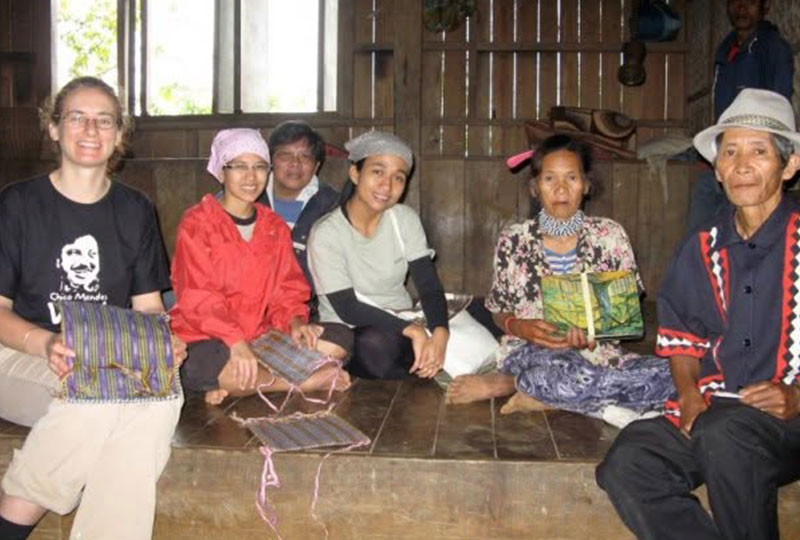
Courtesy visit to Datu Amay Mantangkilan and his wife during 2009 field testing of Non-timber Forest Products (NTFP) assessment and monitoring tools in Bukidnon, Philippines with academics and government foresters. © NTFP Asia
Asia’s Amazon
Which other Southeast Asian countries have you worked in?
I feel very lucky that I’ve been able to work with different local organisations across the region. Most of the partners I worked with have been in Indonesia, Malaysia, and Vietnam.
In Sabah, Malaysia – which is a bit like ‘Asia’s Amazon’ – I’ve seen how local communities and conservation organisations can protect their environment. For my first field visit with Synchronicity Earth, I was able to return to Sabah to visit Buayan village. The community members of Buayan are part of a local organisation called TAKAD. Through their TAGAL system, they are protecting their forest and local community, and this has been sustainable over time. I first went there in 2008, and they’ve been successfully protecting their village against a large dam project ever since.
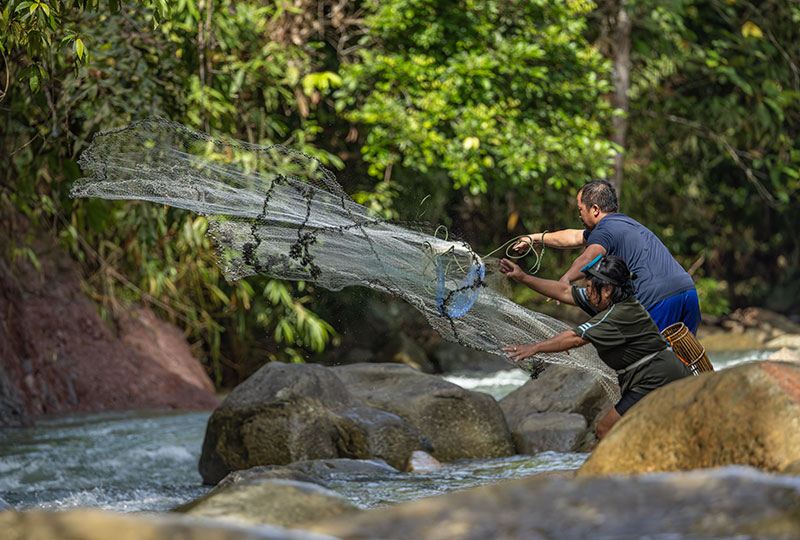
Fishing using the tagal system, an indigenous stewardship approach to managing natural resources. Dusun community, Sabah, Borneo. © Chris Scarffe
Closing the capacity gap
Q: You started at Synchronicity Earth in February. In your role you work across different programmes (oceans, freshwater, and Asian species). What conservation gaps do you see in those different ecosystems or programme areas, and what are the most persistent challenges faced by local organisations?
Since joining, I’ve found it so inspiring to attend partner meetings and see different conservation leaders from Asia doing so many different types of work. I can really see the capacity of these leaders growing.
One of the biggest gaps local organisations are facing – whatever their focus – is the lack of support for organisational capacity; things like operational costs, salaries, and training.
Organisations often find it difficult to retain staff or have any kind of succession plan. A lot of conservationists in the region struggle with very low salaries and feel burnt out. Over the past year in particular, there’s been growing uncertainty about funding, and conservation continues to be made more complex and challenging by the growing impacts of climate change.
I’ve noticed that a lot of conservation in the region is still ‘siloed’: conservation organisations don’t always collaborate together or support each other as much as they should. I think there are huge opportunities for greater collaboration and learning, but there needs to be increased recognition and support for these kinds of opportunity.
Lastly, even when organisations do have a lot of success and great stories to tell, they sometimes struggle to communicate and document their impact. Translating results into evidence that policymakers and funders can understand remains very challenging.
What does good capacity strengthening look like?
Q: When capacity strengthening is done well, what does that look like, and what are the important things to consider for it to be truly effective?
For me, it is key that funders supporting capacity strengthening recognise that communities and local NGOs already have their own strengths and capacities. Sometimes it’s just about building their confidence and helping them to trust their own strengths. And if you build that confidence and trust for them, they can achieve so much.
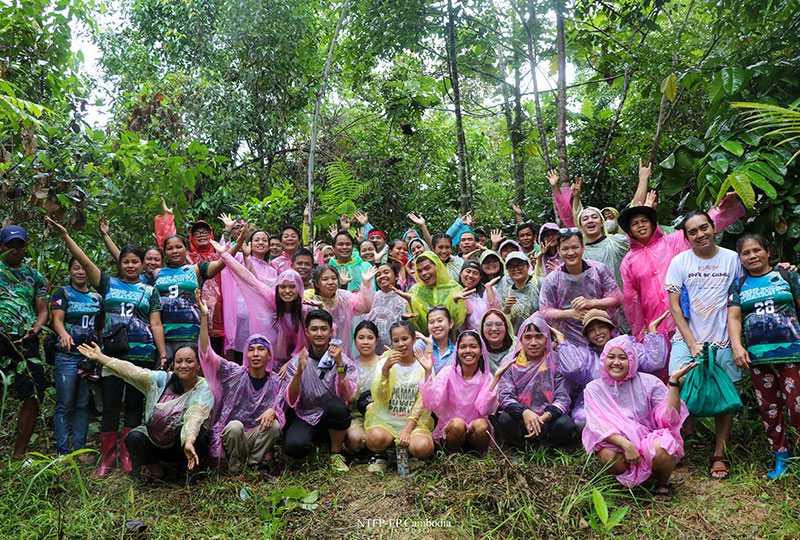
The YEEHA! Regional Youth Camp (June 4–10, 2025, Puerto Princesa, Palawan) gathered 43 young IPs & local community leaders from Cambodia, Lao PDR, Philippines, Malaysia, Indonesia, Myanmar, and Vietnam to strengthen youth leadership in forest governance and climate action. © NFTP Asia
How can the role of regional affiliates, like yourself, support that process?
Each programme has multiple partners and distance makes it harder to capture things which the partner might not think are important: they might be focused on reporting what they think the funder wants them to say, but as an affiliate you can recognise that they have many other stories and examples that would be relevant and interesting to funders.
Affiliates help to bridge the knowledge gap, strengthening connections with partners and helping to understand them better.
Understanding impact
Q: How can good Monitoring, Evaluation, and Learning (MEL) improve outcomes and be useful for partners working at community level?
More often than not, MEL frameworks are designed primarily for donor reporting and don’t necessarily consider what matters for the community and the partners. In my view, it’s vital to include partner communities in designing the MEL process, to consider together what is expected, what the target outcomes are, what is working and what is not, and the impacts they are trying to achieve, so they can maximise resources.
It’s just as important to have conversations with funders as well to deepen their understanding. This can bring things out that might be important at a community level but don’t make it into grant reports because they don’t fit into a particular MEL framework.
Measuring long-term change is very challenging – you often need many years to be able to see impact. You really need to keep the focus on outcomes, and the only way to genuinely understand those is through ongoing conversations with partners.
Partners that inspire you
Q: From your time at Synchronicity Earth so far, what has been a particular highlight for you?
It’s been amazing to meet so many conservation leaders despite all these challenges and to see the level of interest in conservation in Southeast Asia. Too many organisations to name, but I’ve been really impressed with Kiara, in Indonesia, who are working with local people, developing livelihoods through their embroidery collective and living in harmony with the Endangered Javan gibbon. The impacts of what they are doing there extend far beyond conservation and are a source of huge pride for the women in the community.
There is also Mabuwaya, who work with Indigenous communities, helping to get recognition from the local government and working with different stakeholders to change the image of the Philippine crocodile for Filipinos. TAKAD is another organisation I’ve been really impressed with.
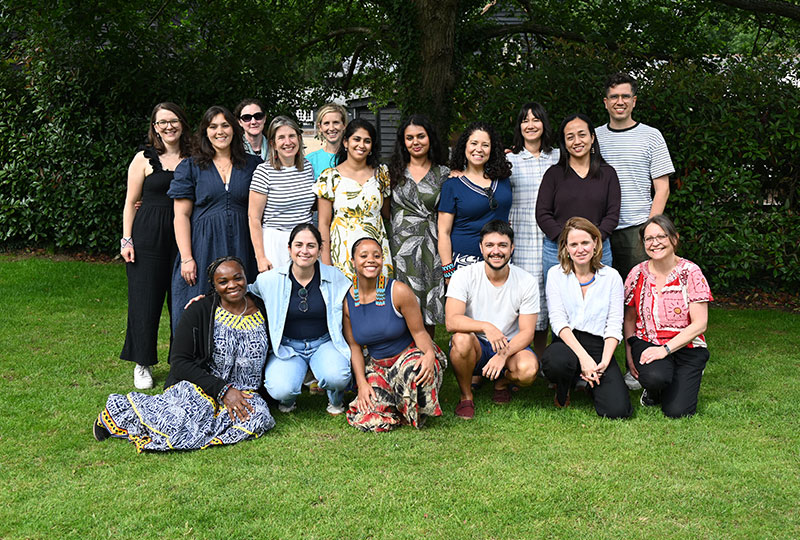
Kate (top row, second from right) with the Synchronicity Earth Programmes Team, June 2026. © Synchronicity Earth
Shifting power for a better future
Q: When you picture what nature in the Philippines and the wider region could look like in 20 or 30 years’ time, what does a hopeful future look like?
Well, I’ve already seen success stories where Indigenous Peoples and local communities have become much more involved in important dialogues and decision-making.
For me, a hopeful future is one where diversity is thriving with empowered local communities and conservation leaders, because this is the only way that it can be truly sustainable.
I want to see people in Southeast Asia living in a healthy environment, where both their rights and the rights of nature are recognised and protected.
I am optimistic because I’ve seen how community empowerment in places like Palawan can really shift power, even when those communities are living in poverty. Understanding and recognising rights is key to protecting these communities. The kind of trust-based funding provided by Synchronicity Earth can support local organisations and conservation leaders to do that. Seeing this has also inspired me!
And one last question – since you first started your marine mammology class, have you now learned to swim?
Yes! I wouldn’t call myself a strong swimmer, but I’m very comfortable in the ocean. I spent many years freediving and scuba diving with the Tagbanua and other fisherfolk in my 10 years in Palawan. My best times were encounters with stingrays and sea turtles, and being part of teams rescuing dugongs and dolphins, memories which will stay with me forever.
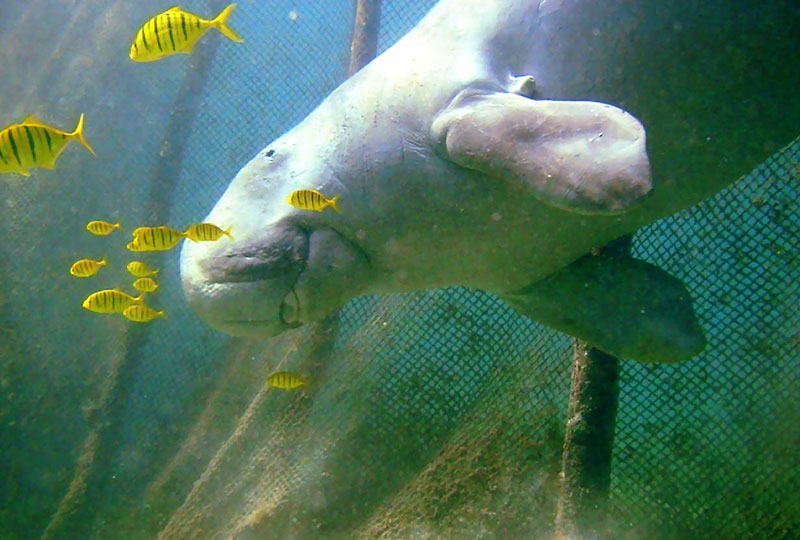
Rescue of a trapped dugong in Honda Bay, 2003. Kate, as part of the Palawan Marine Mammal Rescue Society (PMMRS), a collaboration of different stakeholders including WWF, ELAC, and Conservation International, helped rescue the dugong after it was caught in a fish corral. © PMMRS
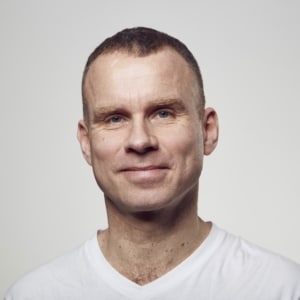
Kate works as an affiliate at Synchronicity Earth where her work in the Philippines continues to inform her career dedicated to protecting Asian species, communities, and ecosystems.
Learn more about our Youth Affiliate Swetha Stotra Bhashyam and our Congo Basin Affiliates Bihini Won wa Musiti Jean and Julie Gagoe Tchoko and Merline Touko Tchoko.