
The culture we ‘swim in’
The big picture
Every organisation operates within a wider cultural context: the background of assumptions, stories, norms, and relationships that shape what seems possible, whose knowledge is valued, and the causes and beliefs that people choose to prioritise. But we do not always give these elements the attention they deserve; cultural norms, beliefs, and practices become so ingrained as to be invisible to us.
“There are these two young fish swimming along and they happen to meet an older fish swimming the other way, who nods at them and says ‘Morning, boys. How’s the water?’ And the two young fish swim on for a bit, and then eventually one of them looks over at the other and goes ‘What the hell is water?’”
– David Foster Wallace*
* This quote is from a college commencement speech made by the late novelist David Foster Wallace, and is based on a proverb of Ewe origin (the Ewe people live in parts of West Africa including areas of Ghana, Benin, Nigeria, and Togo).
Cultural context
We are committed to exploring how cultural norms and beliefs drive nature loss and weaken our sense of connection to the natural world. In many so-called ‘developed’ societies, the underlying culture and dominant narratives support economic and political systems that treat nature as a commodity or externality rather than as something we are all part of and rely on. While we recognise the deep roots of these systemic issues, we believe there are different and better ways to do things which deserve to be explored and that over time, a cultural shift is needed.
We fund organisations, participate in dialogues, and collaborate with others in the sector to make the culture we ‘swim in’ more visible and to question prevailing ways of doing things in areas such as finance, law, and our relationship to nature.

Red fox on a London street. Image: Neil Aldridge, iStock
Stories from the ‘field’
Holding finance to account
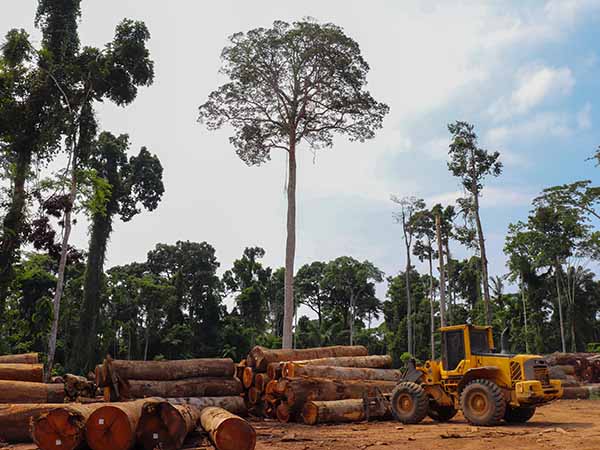
Logging in the Brazilian Amazon. iStock
By financing activities across a wide range of sectors, many banks and investors continue to be leading contributors to biodiversity loss. The true value of nature is ignored, with the natural world considered an ‘externality’ rather than the foundation on which everything else depends. Changing that approach so that banks and investors fully consider environmental impacts and risks requires advocacy that can both work with regulators to strengthen environmental protections and work with investors to use their engagement opportunities with companies, including banks, to improve environmental outcomes.
Rainforest Action Network (RAN) is a member of the Forests and Finance Coalition, which conducts in-depth research to identify the corporate and financial actors most responsible for driving deforestation, climate change, and human rights abuses.
Synchronicity Earth supports RAN’s work to reduce financial flows that drive deforestation in Southeast Asia. This is a combination of policy advocacy with key regulators in Asia and coordinating investor engagement to reduce deforestation in the region.
“There are very few funders that give to work related to biodiversity and finance, yet it’s such a systemic issue (…) Given the long-term engagement needed to change policy and engage with the finance sector, providing core cost and flexible funding is crucial.”
– Catherine Bryan, Co-Chair of Trustees, Synchronicity Earth
When nature has a voice
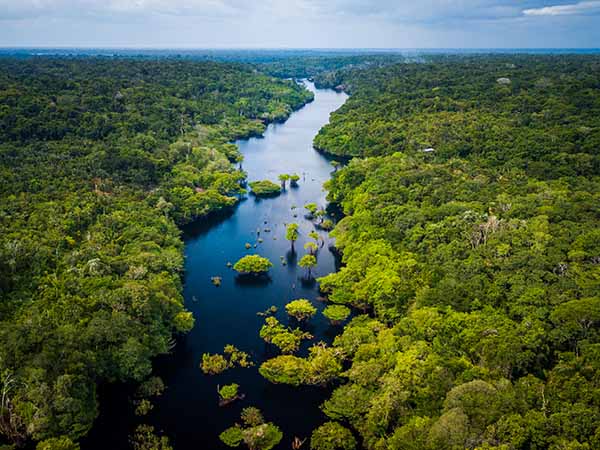
Drone image of a blackwater river in the Amazon Basin near the city of Novo Airão, Brazil. iStock
Global Alliance for Rights of Nature (GARN) was founded in 2010 by global leaders who helped power the Universal Declaration of the Rights of Mother Earth at the People’s Conference on Climate Change and the Rights of Mother Earth in Bolivia and the Constitutional recognition of the Rights of Nature in Ecuador. These leaders then established an Alliance that could drive the Rights of Nature movement to address the ‘polycrisis’ of climate change, biodiversity loss, and social inequality.
GARN exists to challenge the paradigm of nature as property, a resource to be owned, exploited, and traded. It advocates for legal and cultural frameworks that recognise nature as a rights-bearing entity in its own right. It remains the only truly global alliance focused on this work, drawing on Indigenous and local community concepts of living nature to shift the legal and cultural foundations of how humanity relates to the world around it.
Synchronicity Earth provides core funding to GARN, support that is difficult to access but essential for an organisation working at this scale. We see this as an opportunity to help catalyse a growing movement and to learn from approaches that directly challenge the extractive logic at the heart of the environmental crisis.
Listen to GARN’s podcast ‘Conversations with Mother Nature’ to learn more about their work.
“Synchronicity Earth’s support has provided pivotal resources for GARN, enabling it to consolidate years of leadership into a unified, strategic global movement.”
– GARN