
Alternative Futures
Challenging dominant narratives
The ecological crises we face are real and urgent. But they are also, in part, a failure of imagination, the result of narratives that tell us nature is separate from us, something to be used rather than something we belong to and are part of.
We believe that art, creative practice, and storytelling are part of what it means to be human. They have an essential role to play, sparking imagination and empathy, connecting personal experience to collective meaning, and reaching people that facts and figures alone cannot.
Our global community of partners, affiliates, and allies holds a wealth of biocultural knowledge and practice. We are committed to exploring, alongside artists, storytellers, filmmakers, and cultural institutions, how this knowledge can help challenge dominant narratives and inspire different ways of thinking and feeling about our place within and as part of nature.
We hold to the idea that the arts and culture sectors provide fertile ground to nurture alternative ways of thinking about the more-than-human world and our relationship to it, helping us to imagine futures in which people and nature flourish together.
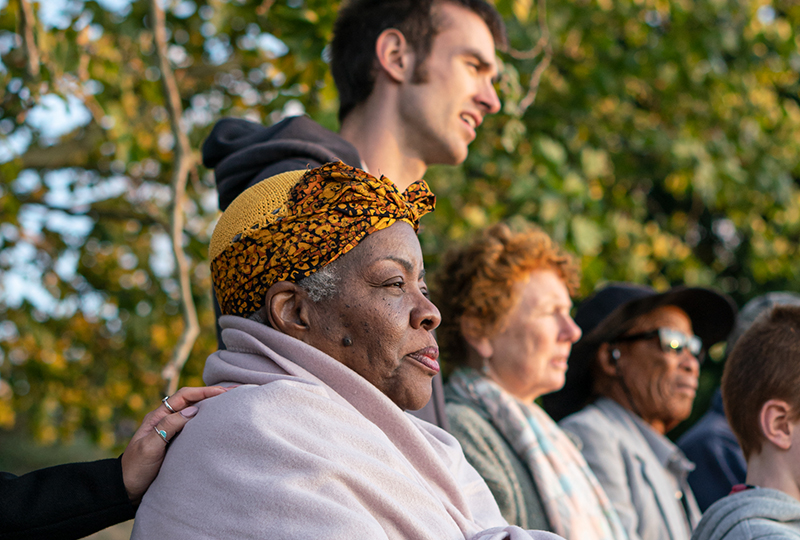
Participants at the closing ceremony of the Flourishing Diversity Summit in Greenwich, London, 2019. © Vivobarefoot
“Science cannot function as a single point of truth through which socio-environmental crises might be imagined, nor as the sole means through which forms of repair might be fostered.”
– Lodovica Guarnieri, Researcher, Designer, and Associate Lecturer at the Royal College of Art, and cultural adviser to Synchronicity Earth
Shifting narratives
The art of listening
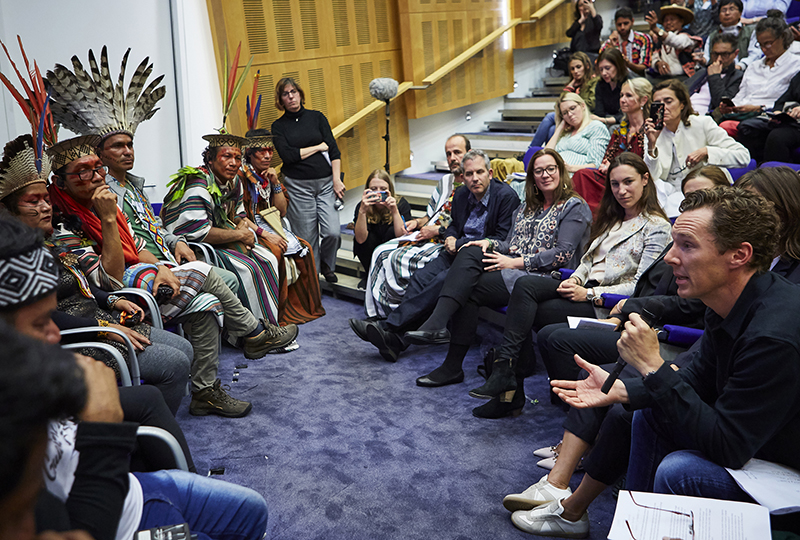
Audience participation during a session at the Flourishing Diversity Summit at UCL, London, 2019
How often are we asked to join a workshop or participate in a space just to listen? Not to debate, discuss, pledge, or present, but just listen? This was the organising principle behind the collaborative Flourishing Diversity Series, and it remains a defining moment in Synchronicity Earth’s development.
In September 2019, Synchronicity Earth collaborated on six Listening Sessions held across various evocative London venues, with further sessions held online and at COP26 in Glasgow in 2021. Each session paired an Indigenous representative with a well-known figure from the worlds of art, politics, business, conservation, or fashion. Those influential voices donated something rare: their silence. By taking an intentional listening role, they embodied the shift the world urgently needs – away from the assumption that solutions flow outward from Western expertise, and towards an openness to Indigenous knowledge, relationships with the land, and ways of living in harmony with the rest of life.
The series, and the Summit co-hosted with University College London, was a formative moment for Synchronicity Earth, deepening our understanding of the connections between nature and culture and directly informing the development of our Biocultural Diversity Programme.
“We invite you to reforest. To reconnect with life. There is nothing better for this than this difficult period we are in, where we have nowhere else to go, where if we continue in this way the planet will be destroyed.”
– Eunice Kerexu, Guarani Yvyrupa Commission and APIB
Whose stories are we telling?
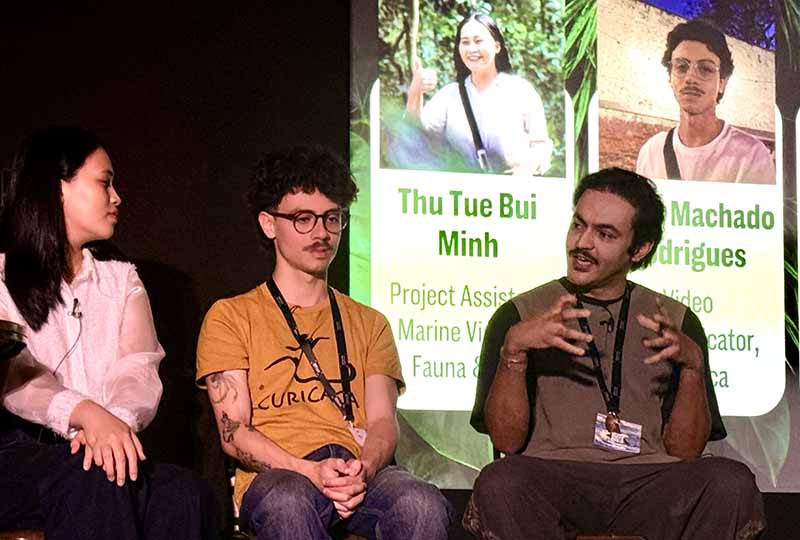
Speakers at the Community Stories, Community Voices event at Wildscreen Industry Summit, October 2025. Image © Jim Pettiward
Whose stories are we telling? And who gets to tell them? These questions sit at the heart of how natural history filmmaking can reflect the extraordinary diversity of people and communities and the environments they are working to protect, or simply reinforce existing perspectives and priorities and a narrow Western view of what conservation looks like.
Synchronicity Earth convened a discussion at the Wildscreen Industry Summit, one of the most significant moments in the natural world storytelling calendar, working with Wildscreen and writer and broadcaster Liz Bonnin to bring together young and established filmmakers alongside partners from our wider network. Speaking to an audience of high-level producers, directors, and industry representatives, the session made the case for less extractive approaches to storytelling: narratives rooted in local knowledge, told with rather than about the communities at their centre.
SE believes in the power of film to shift what people think is possible. By bringing two young filmmakers from partner organisations in Brazil and Vietnam into this space, and hearing from an established local filmmaker we have worked with in Madagascar, we ensured that voices and perspectives not normally heard at industry level had a seat at the table.
Our commitment to this space runs deeper than a single event. Co-founder Jessica Sweidan sits on the Wildscreen Board, and the Aurum Kaleidoscope Foundation supports the Industry Summit to sustain natural history storytelling for the long term.
“Attending the Wildscreen Industry Summit was a huge opportunity for me to connect, share openly, and express my journey of seeking pathways to tell stories about nature and indigenous communities in Vietnam. These stories are deeply important for cultural and environmental preservation, yet often underrepresented. Being part of this space not only allowed me to be heard, but also strengthened my belief in the path I’ve chosen – especially knowing there is a community willing to listen and support. Synchronicity Earth’s support made that experience possible and truly meaningful.”
– Tue Thu Bui Minh, Project Assistant (Marine) Fauna and Flora International