Synchronicity Earth is delighted to welcome three new Trustees to our Board: Mike Barclay, Salisha Chandra, and Kristen Walker-Painemilla.
Following a wide-ranging recruitment process, our new Trustees will bring their experience in the charitable and private sectors across Asian, African, and American regions.
Our new trustees are arriving at an important time, as we look towards the end of our current 2023-2027 strategy.
“As we continue to grow the scale and ambition of funding across our programmes, we are delighted to welcome Salisha, Mike, and Kristen to our board,” says Catherine Bryan, Co-Chair of the Board of Trustees.
“Collectively they bring vast regional expertise, incredible skill in organisational development, and distinct experience working with local and Indigenous communities, as well as wider scientific communities housed in zoos and other global institutions.”
Synchronicity Earth provided £6.4 million in funding to 161 partners in 41 countries in 2025 and our target for funding for 2026 is £7-8 million.
“Given the range and amount of work funded by Synchronicity Earth, inviting new trustees with different experiences felt important and timely,” says Adam Sweidan, Co-Founder and Co-Chair of the Board of Trustees.
“As they spend time with our team and get to know our programmatic work in more depth, we know they will add so much value, helping us guide the organisation successfully through the coming years as we support our partner organisations to increase their impact in protecting and restoring species and landscapes.”
Mike Barclay
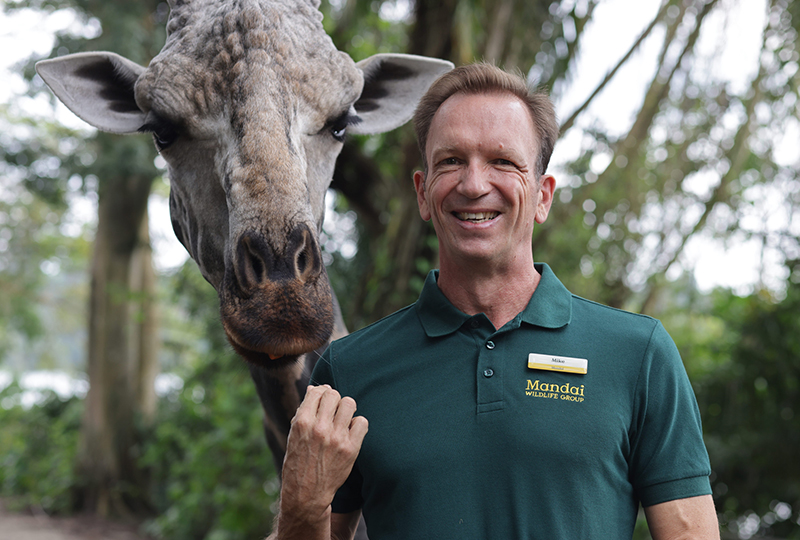
Mike Barclay with a giraffe in Singapore Zoo, within the Mandai Wildlife Reserve.
Mike Barclay has recently retired from Mandai Wildlife Group, where he was CEO for ten years. During his tenure he oversaw the transformation of the Mandai Wildlife Reserve into a world-leading nature and wildlife destination.
As well as the physical transformation, Mandai Wildlife Group has also grown as a funder for important conservation projects in Southeast Asia. The Mandai Wildlife Group now supports about 50 conservation projects in the region.
Previously, Mike was CEO of Sentosa Development Corporation, a statutory board under Singapore’s Ministry of Trade and Industry, which oversees the development, management, and promotion of Sentosa Island as a tourism destination. He restructured the company and increased tourist numbers from 5.6 million in 2007 to almost 20 million in 2013.
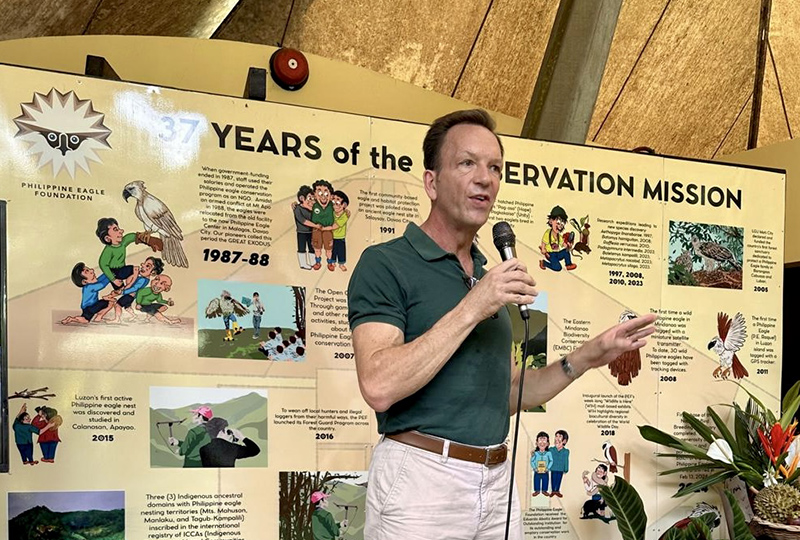
Mike speaking about Philippine eagle conservation.
“Having lived and worked in Southeast Asia for almost 30 years, I have a good feel for political, economic, and social issues across the region,” says Mike. “I have also visited conservation projects in a number of Asian countries, which has helped me to understand how organisations operate in the field.
“Most field projects are having to grapple with a cut in their funding, in large part driven by the withdrawal of USAID and the downsizing of government support from many other developed countries. It is therefore increasingly important for conservation funders to consider how to maximise the positive impact of their grants and to learn from our past funding experiences.
“I am most excited by the scale and breadth of Synchronicity Earth’s ambition for the coming years, and the opportunity to get to know the incredible group of people who work for or with Synchronicity Earth. I am humbled to join this ecosystem of forward looking and action-orientated conservationists!”
Salisha Chandra
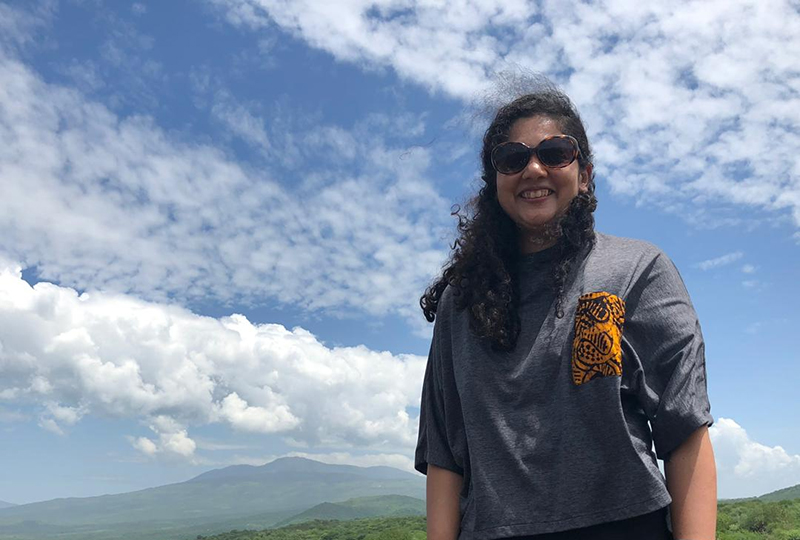
Salisha Chandra on a hiking trip.
A “rebel with too many causes”, Salisha plays many different roles across her various passions as an activist, conservationist, and adventurer. She left her corporate career in 2012 to focus on environmental work.
She was the Founding Director of a grassroots conservation movement, Kenyans United Against Poaching Trust, before joining Lion Guardians, where she spent over a decade and now serves as a Director. She later joined BirdLife International, where she led the coordination of an Africa-wide strategy to protect vultures.
Most recently, she has become the Strategic Initiatives Director of Maliasili, a funder supporting community-led conservation organisations across Africa. Given its similar approach to innovative and flexible support for partners, Maliasili has been a frequent collaborator of Synchronicity Earth’s: co-authoring a paper on better climate funding, co-running the Reimagining Conservation Pavilion at the IUCN World Conservation Congress 2025, and co-authoring two reports on better environmental funding: Greening the grassroots and From pledges to practice.
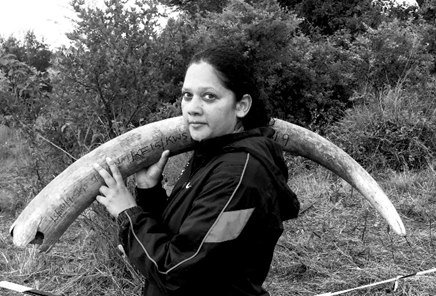
Salisha Chandra with an elephant tusk.
“From my experience working with grassroots organisations across Africa, one of the most important priorities for conservation today is supporting organisations that are restoring, reclaiming, and redefining the rights of communities to their land and natural resource,” says Salisha. “Many of the most effective conservation efforts are already locally led, but are often constrained by insecure land tenure, limited decision-making power, and funding systems that do not fully reach or reflect those closest to the work.
“Alongside this, there is a need to shift how funding flows – ensuring that local organisations, leaders, and communities are receiving a far greater share of conservation resources, in ways that are flexible, long-term, and aligned with their realities.”
Salisha Chandra
Kristen Walker-Painemilla
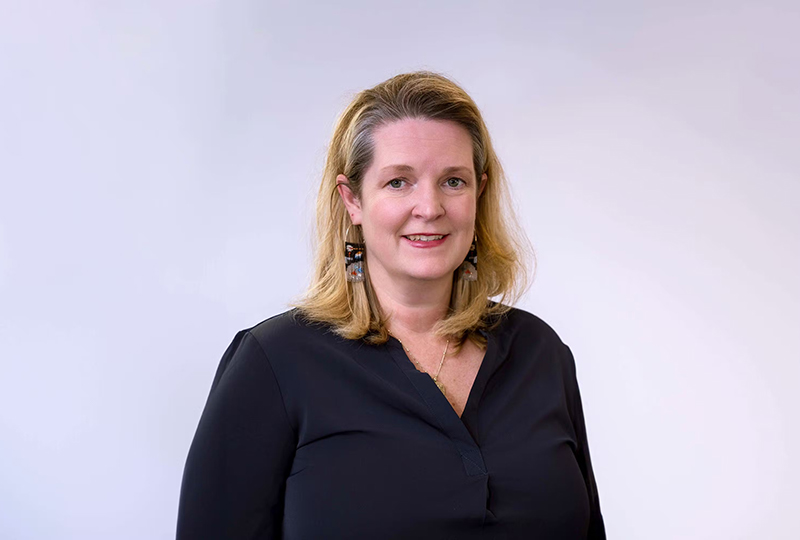
Kristen Walker-Painemilla.
Like Mike and Salisha, Kristen has also shown long-term dedication to the organisations she has been a part of over her career. She has spent 25 years at Conservation International, where she is now Senior Vice President (Inclusive Finance) and nine years at the IUCN Commission on Environmental, Economics, and Social Policy (CEESP), where she served as Chair.
At the heart of Kristen’s work is the conviction that effective conservation can only be achieved with and through the leadership and cooperation of Indigenous Peoples and local communities. Building on this foundation, her work has focused on advancing human rights and governance in conservation, from establishing the Indigenous and Traditional Peoples Program in 2003 to supporting broader institutional approaches.
As the Chair of CEESP, she has also dedicated herself to the Reimagining Conservation initiative, which recognises that the crises of today require a transformative, collaborative, and equitable approach to conservation (as expanded on in an issue of IUCN CEESP’s Policy Matters publication).
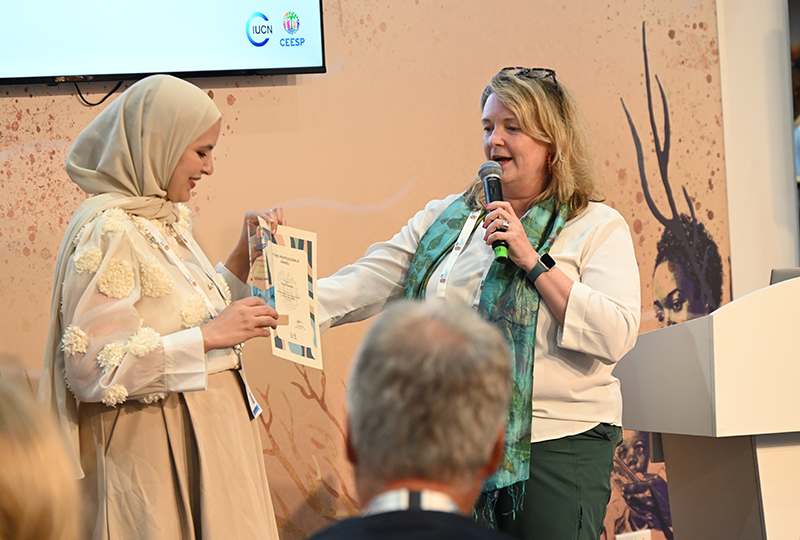
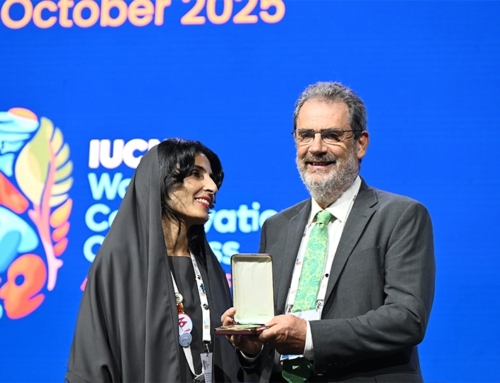
Kristen presenting Fatima El-Aaraby with the IUCN CEESP Young Professional Award at IUCN World Conservation Congress 2025. Image © Geanie Cresswell
“My time with IUCN CEESP has really shaped how I think about conservation – not just as something we do, but as something we need to fundamentally rethink,” says Kristen. “For me, reimagining conservation is about relationships: how we relate to nature, and how we relate to each other in the process.
“What I hope to bring to Synchronicity Earth’s board is that perspective: grounded in equity, governance, and the recognition that there isn’t just one way of knowing or caring for nature. Some of the most powerful lessons I’ve learned have come from Indigenous Peoples and local communities, whose knowledge systems and leadership are too often undervalued.
“I’m excited to contribute to conversations that push us to go further – to question who holds power, how decisions are made, and how we can support approaches that are more inclusive, more grounded, and ultimately more effective.”
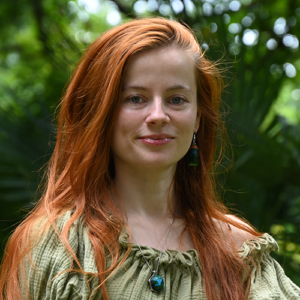
Mike, Salisha, and Kristen will be appointed to the Synchronicity Earth Board before our AGM in June 2026. They join our existing six Trustees, who you can learn more about on Our People page.
Please note that Synchronicity Earth USA has an independent board with six trustees chaired by Jessica Sweidan, as a non-profit organisation set up to support the work of and raise funds for the UK-registered charity Synchronicity Earth from the United States.