This International Women’s Day, we spoke to women leaders working to conserve the Congo Basin about leadership, resilience, and what it really means to protect one of the world’s most vital ecosystems.
The four women featured here – Blandine Bonianga Ilanga, Merline Touko Tchoko, Mireille Kayijamahe, and Chouchou Mpunga Losale – recently came together through a wellness retreat organised by Terra Mucho, a programme supported by Synchronicity Earth that accompanies women committed to environmental protection and sustainable development.
As Merline wrote afterwards, the retreat brought together nine women from Cameroon and the Democratic Republic of Congo – all sceptical, all carrying the weight of overcommitment – and offered them something rarely built into the work: space to reflect, restore, and be seen. Below, they reflect honestly on what that work demands.
Blandine Bonianga Ilanga
Coordinator – Dynamique des Femmes pour l’Environnement et le Développement (DYFED)
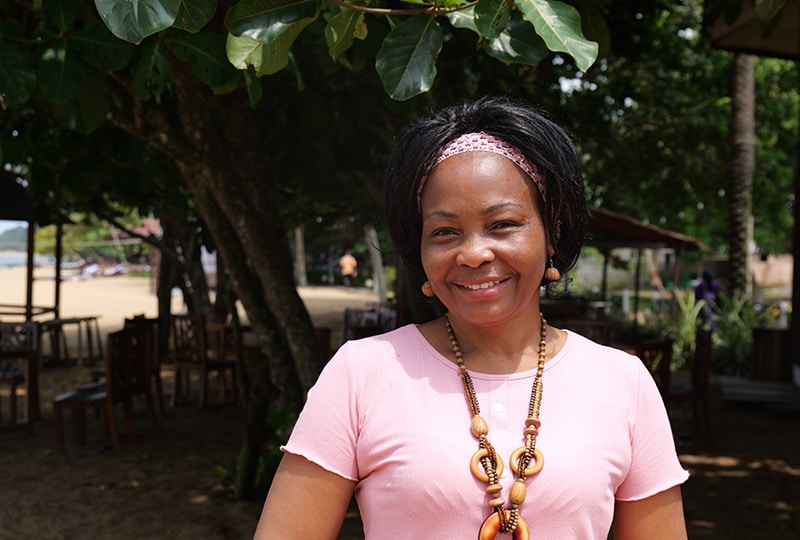
© Terra Mucho
What does it really mean to be a woman leader in the conservation of the Congo Basin?
For me, being a woman leader means, above all, being a voice that matters. A voice that dares to speak up to encourage, train and mobilise other women to become empowered and to take concrete action in protecting our environment.
The Congo Basin is the world’s second lung, an extraordinary ecological and economic treasure. Yet it also faces immense challenges: poverty, unsustainable resource exploitation, and gender inequality. My role is to transform these obstacles into opportunities and to foster locally driven solutions led by women who understand that they have the power to act.
What aspects or constraints of your work often remain invisible to the public?
There is much that people do not see: the sometimes frustratingly slow pace of community engagement; the significant logistical and financial challenges; institutional weaknesses and corruption that hinder progress.
There is also the constant tension between rapid economic development and environmental protection; security risks; the psychological pressure of confronting global crises such as climate change; and, of course, the impact on family life and personal health.
Being a woman leader in the environmental sector therefore means operating in a context of high exposure and vulnerability.
If you could challenge one misconception about women engaged in protecting the Congo Basin, what would it be?
I would like us to move beyond reducing women to domestic roles or to the symbolic position of mere ‘guardians’ of nature. Women are not here simply to decorate or to nurture the planet in a metaphorical sense.
They must be able to occupy political, strategic and administrative positions within the environmental sector. Fully recognising their role in decision-making processes is essential if we are to raise awareness and bring about lasting societal transformation.
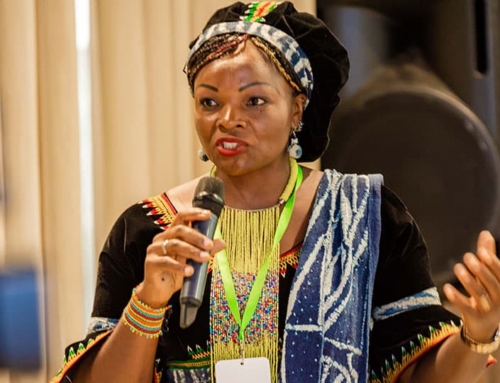
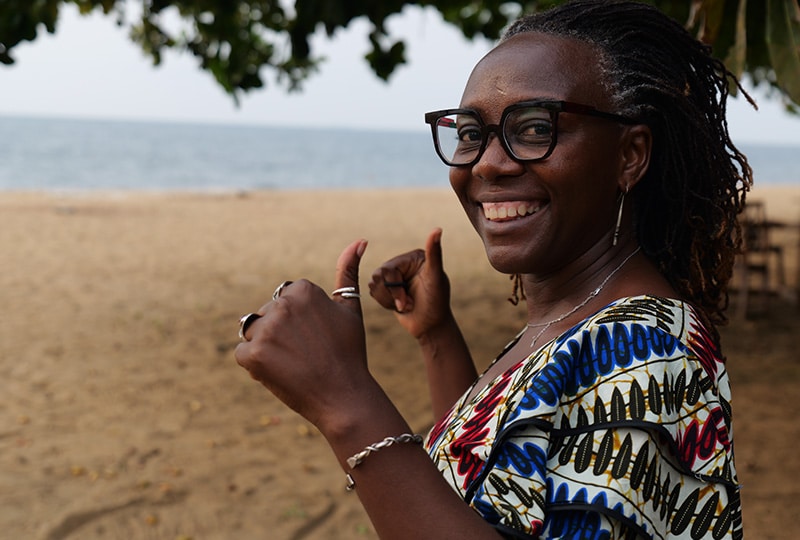
Merline Touko Tchoko
Congo Basin Affiliate, Synchronicity Earth and Communications Consultant

© Terra Mucho
What does it really mean to be a woman leader in the conservation of the Congo Basin?
Being a woman leader in the conservation of the Congo Basin is not simply about holding a position. It is about navigating spaces where decisions are often made by men, while carrying a vision grounded in local realities.
It means combining technical expertise, emotional intelligence and political courage. It means defending the forests while also defending one’s legitimacy at the decision-making table. It requires the ability to speak to local communities, international donors and public authorities without losing one’s sense of place.
Conservation work here is deeply intertwined with issues of governance, poverty, gender and power. Far beyond protecting trees, protecting the Congo Basin is about navigating complex human, social and economic realities.
What has been the most difficult moment in your journey, and how did you overcome it?
The most difficult moment was not a dramatic event, but rather a quiet accumulation: the constant need to prove my competence in spaces where doubt often precedes listening.
There is also the ongoing tension between professional commitment and social expectations. Being ambitious in environmental conservation can make others uncomfortable.
I overcame this by developing two strengths: mastery of my subject and mastery of my narrative. I came to understand that in the conservation of the Congo Basin, it is not enough to be scientifically right – one must also explain why it matters.
What role has support or the lack of it played in your journey?
Support has been decisive, although not always consistent.
There have been mentors, colleagues, and inspiring women such as Sophie from Synchronicity Earth who reminded me that my voice had its place. Their recognition was often a powerful source of confidence for me.
However, at times, the absence of support required me to develop strong intellectual and emotional independence.
Today, I firmly believe in women’s solidarity within Congo Basin conservation. We need safe networks where we can share doubts without losing credibility.
You can read Merline’s reflections on the Terra Mucho retreat (in French).
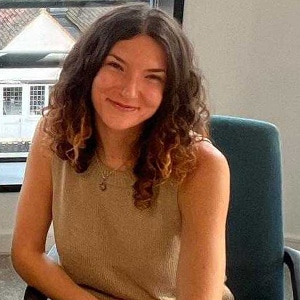
Mireille Kayijamahe
Founder and Director, Terra Mucho
© Terra Mucho
What has been the most difficult moment in your journey, and how did you overcome it?
The most difficult moment was founding Terra Mucho. The uncertainty was immense: not knowing whether the project would be well received, despite my deep conviction of its importance. There were numerous professional barriers, and on a personal level, many questions arose… was it the right time? Was I too young? What about my children?
What ultimately pushed me forward was a very concrete observation. Although I have strong experience in training and women’s leadership, when organising workshops I struggled to identify visible and recognised women leaders in the sub-region. Their absence was striking – not because they did not exist, but because they were not seen.
That lack of visibility strengthened my determination.
Creating Terra Mucho meant acting on something I had consciously chosen. It meant becoming the author of my own story. It meant moving beyond a position of powerlessness and helping other women become authors of their own destinies and, above all, tell their own stories.
In many ways, it was also a response… almost a symbolic act of reclaiming power in the face of the helplessness I had witnessed in my region of origin.
What realities or constraints of your work often remain unseen by the public?
First, there is the privilege of accompanying women. Standing alongside them means being confronted with powerful realities, with strong women who are nevertheless often rendered invisible.
What people also do not see is the spider behind the web. I describe Terra Mucho as a ‘spider’s web’ connecting women to one another, to opportunities, to their full potential; helping them see themselves, accept themselves, and move forward. Being a bridge between the invisible woman and the active, visible woman is an immense privilege but it is also demanding.
Finally, what remains unseen is the constant logistical burden, and the continuous effort not to pass on one’s own anxieties to the team or to partners, while still holding the course. Behind all of this, there is sometimes the quiet sacrifice of comfort and routine.
If you could challenge one misconception about women engaged in protecting the Congo Basin, what would it be?
The idea that women working in the Congo Basin are rare, heroic exceptions – extraordinary and uncommon. The reality is quite different: they are numerous.
Yet they are not recognised, not seen, and sometimes they do not fully claim their own leadership, even though they are moving mountains, often on a small scale, often in the shadows, yet with real impact.
That is precisely the mission Terra Mucho has set itself: not only to make these women visible, but to help them acknowledge and embrace their skills. Because an enlightened, empowered, and self-aware woman is a woman who transforms her environment.
You can listen to Mirielle’s podcast featuring Blandine (in French).
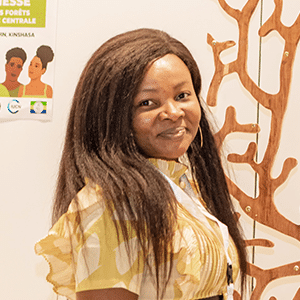
Chouchou Mpunga Losale
Previously Vice-Coordinator and Head of Planning and Programmes, CFLEDD – Chair of the Board and Founder, NGO CEPF

© Terra Mucho
What does it really mean to be a woman leader in the conservation of the Congo Basin?
For me, being a woman leader first means carrying a clear vision and being able to bring people together around that vision.
I strongly believe that a woman leader brings together other women whose aspirations align. She creates synergy between skills, energy and efforts to drive shared change. I do not work in pursuit of personal gain, but to create lasting impact.
I make a distinction between management and leadership. A manager organises; a leader inspires. I strive to recognise the abilities of others, to delegate with trust, to value people’s efforts, and to create a space where everyone can contribute fully.
In the Congo Basin, this kind of leadership is a powerful lever for collective transformation.
What has been the most difficult moment in your journey, and how did you overcome it?
The most difficult moment for me was the misunderstanding of my leadership by those around me – colleagues, family members, and my immediate environment.
Being an assertive woman in decision-making spaces can create resistance. I faced critical looks, doubts, and sometimes judgement. But I refused to give up. I drew my strength from that determination. Leadership training also helped me to fully embrace my role and strengthen my confidence.
The personal cost? My time, my energy, and a constant commitment to defending nature and communities, especially women.
What sustained me as well was the determination of the groups I work with. Seeing the gradual ownership of women’s leadership within national, provincial and local entities after our interventions confirmed to me that change was truly underway.
If you could challenge one misconception about women engaged in protecting the Congo Basin, what would it be?
I would challenge the idea that women cannot deliver concrete results, or that when women come together nothing tangible comes out of it.
For me, investing in a woman is investing in a nation. Women carry a natural capacity for transformation. They have demonstrated their ability to drive lasting change in their societies.
I often compare nature to a woman: both require respect, care and recognition of their value. To protect one, you must value the other.

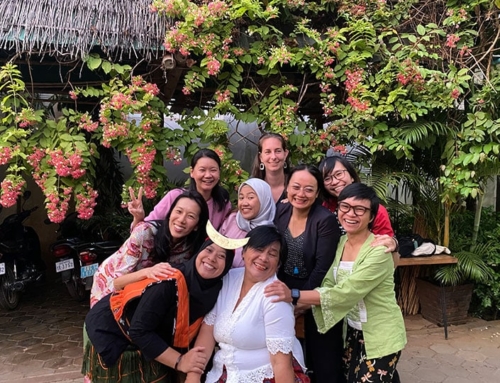
The community of women who gathered for the Terra Mucho retreat. © Terra Mucho
Our Congo Basin Programme supports women, local communities, and Indigenous Peoples to defend their territories and rights, alongside our affiliates who provide crucial local knowledge and guidance for our programme partners.
Sign up for Synchronicity Stories for more inspiring interviews with conservation leaders.